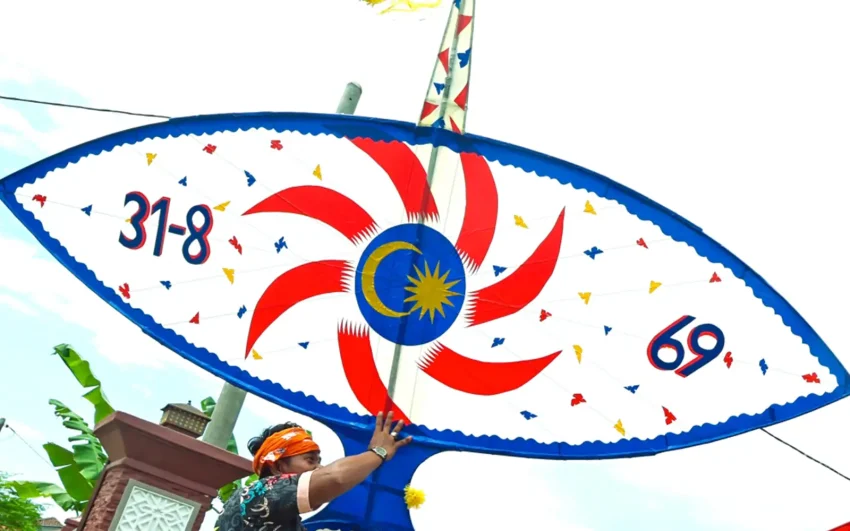

KOTA BHARU: Long before one of Norazizi Mustapha’s giant kites rises into the sky, the real work happens much closer to the ground. There’s bamboo to select, split and dry, a frame to shape, bindings to secure and decorative elements to add.
If the structure is too rigid, the wind will not flow through it properly; too weak, and the kite will struggle to hold its form.
It is a delicate balance the 45-year-old from Binjai has spent years learning. Today, Norazizi can make around 15 types of traditional kites, including the wau bulan, wau kucing, wau puyuh, jala budi and peacock kite.
His latest creations are considerably larger than the average kite. For the upcoming Merdeka Mega Kite Competition at Cherang Laut Beach in Kampung Senok, Bachok, he and Team Sri Bongor are preparing two giant entries: a moon kite and cat kite.
Each measures between 3.4m and 3.6m long, with splashes of Jalur Gemilang colours worked into the designs.
It took around two weeks and RM500 to complete them with the help of his friends Wan Syamsul Maariff Halim and Muhamad Syahmi Rosdi.
Learning from failure
Norazizi’s fascination with kites dates back to his schooldays, when he watched a friend’s father make different traditional designs.
His first attempt at a moon kite was far from successful. But instead of giving up, he spent about a year taking the craft more seriously, learning everything from selecting bamboo and shaping the frame to tying and decorating the kite “so that it was not only beautiful but could fly well”.

The process remains painstaking. Older bamboo is preferred because it is more durable.
Once split and dried, it is carefully shaped into the frame before the kite is tied, decorated and fitted with features such as jerabu, or decorative fringe, and a bow that produces a distinctive sound in flight.
Depending on the complexity of the design, a kite may take anywhere from a week to two months to complete.
“The most challenging part is forming the frame,” Norazizi said. “If it is too strong, the wind cannot enter properly and the kite will be difficult to fly.”
Making a mega kite is only half the challenge – getting it into the air requires a coordinated team effort. At least eight people are needed to launch one successfully, Norazizi added.
Four help lift and release the kite while another four manage the line and keep it stable. “When the wind is right and everyone plays their role, only then can the kite rise properly,” he said.
That combination of craft, timing and teamwork drew Norazizi deeper into the tradition when local mega kite competitions began gaining momentum about five years ago.
This year’s event, to be held on Aug 30 and 31, will bring together dozens of large-scale kites, many carrying patriotic motifs for the National Day and Malaysia Day season.

For Norazizi, however, the appeal goes beyond competition. He sees the event as an opportunity to keep Kelantan’s traditional kite-making knowledge visible at a time when fewer young people are familiar with the craft.
The wau bulan, wau puyuh and wau kucing are among the designs closely associated with Kelantan’s cultural identity, and preserving them means preserving the skills required to make them fly.
Norazizi hopes younger Malaysians will take an interest not only in watching these kites fill the sky, but also in learning how they are made.
For him, the beauty lies just as much in the patient work of shaping bamboo and balancing a frame as it does in seeing the finished kite finally catch the wind.