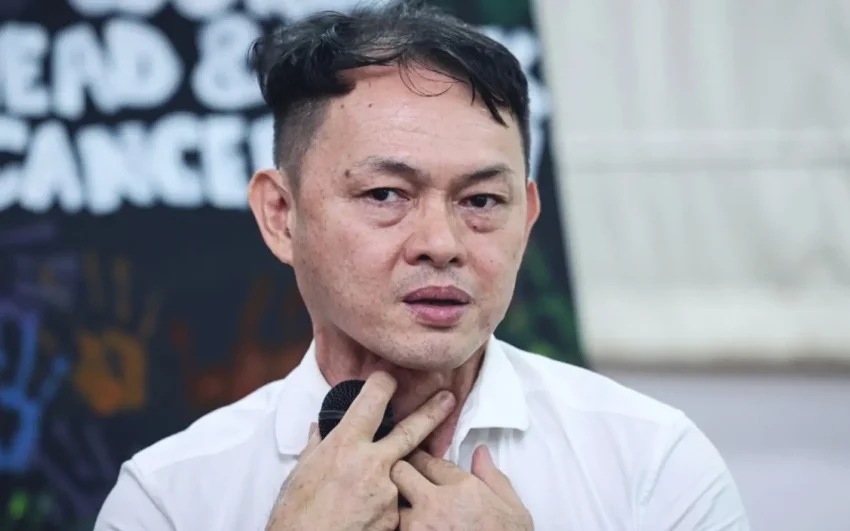

KUALA LUMPUR: When Ang Boon Kok learnt that cancer surgery would require the removal of his voice box, one fear overwhelmed all others – would he ever be able to speak again?
The 51-year-old underwent a total laryngectomy in 2016, leaving him to adjust not only to a major operation but also to an unfamiliar way of communicating.
“When the doctor told me my voice box had to be removed, I was terrified because I thought I would never be able to speak normally again,” he recalled.
Reassurance came from people who understood exactly what he was facing. Through the Malaysia Laryngectomee Association, Ang met other survivors who had undergone the same procedure and rebuilt their lives afterwards.
Seeing them communicate, manage their daily routines, and support one another eased some of his uncertainty about the road ahead.
“After I was introduced to the association and met other patients, I began to feel much more at ease,” he told reporters at a recent event at Hospital Canselor Tuanku Muhriz, Universiti Kebangsaan Malaysia.
The association gave Ang and his family practical guidance, emotional support and a clearer picture of life after surgery. Today, he draws on his own experience to reassure other patients preparing for a laryngectomy.
Learning a different way to speak
A laryngectomy involves removing part or all of the larynx, commonly known as the voice box. The procedure may be required because of cancer, severe injury or serious breathing problems.
After a total laryngectomy, patients breathe through a permanent opening in the neck known as a stoma. As the vocal cords are removed with the larynx, they must also learn a new way to produce speech.
Ang communicates with the help of a voice prosthesis, a small one-way valve placed between the windpipe and oesophagus. Air from the lungs passes through it and creates vibrations that can be shaped into words using the mouth and tongue.
The process took time and patience. “In the beginning, it was difficult because I had to get used to speaking in a completely different way,” he said. “Sometimes, people hearing my voice for the first time struggled to understand what I was saying.”
With practice and support, communication gradually became easier. Ang has since adapted well, remains free of pain and enjoys travelling with his family.
His progress has also allowed him to become the person he once needed: someone who can show newly diagnosed patients that life after the operation remains full of possibility.

Before his diagnosis, Ang worked as a supervisor at a paper-processing plant. His first warning sign was persistent hoarseness that did not improve after treatment at an ear, nose and throat clinic.
Further tests at HCTM UKM, including a biopsy, confirmed a tumour in his voice box.
Although Ang is a non-smoker, he has a family history of cancer. He initially underwent radiotherapy, but follow-up examinations about six months later showed that the cancer remained and had continued to grow.
A total laryngectomy then became necessary.
Consultant otorhinolaryngologist-head and neck surgeon Dr Lum Sai Guan said persistent hoarseness or a change in voice quality lasting more than three weeks should not be ignored.
While hoarseness is often caused by less serious conditions, a prolonged change warrants medical attention, particularly when accompanied by other symptoms or known risk factors.
Smoking remains the leading risk factor for laryngeal cancer, with excessive alcohol consumption also increasing the likelihood of developing the disease.
“If detected early, there is still a good chance of preserving the patient’s voice box through radiotherapy or laser surgery, without the need for a total laryngectomy,” Lum said.
Support beyond the hospital
Surgery and medical treatment address the disease, but survivors may still need help adjusting to changes in speech, breathing, eating and social interaction.
This is where peer support can make a considerable difference. Fellow laryngectomees can share practical advice while offering something clinicians cannot always provide: firsthand proof that the initial fear and uncertainty can become manageable.
For Ang, meeting other survivors replaced some of the frightening unknowns with realistic expectations and encouragement.
Nine years after his surgery, he is no longer simply receiving that support. By speaking openly about his experience and guiding others through theirs, he is helping ensure new patients do not have to face the same journey alone.